Category Archives: Singapore

Some North Koreans Get Business Internships in Singapore

Published by The Atlantic, June 11, 2013

While world leaders bluster, young professionals in Southeast Asia build bridges with their peers from Pyongyang.

Tom Benner

The nuclear threats, rocket launches, and violent rhetoric out of North Korean over the past few months have been countered by the international community with everything from diplomatic condemnations, economic sanctions, and displays of military hardware, all with the elusive goal of reducing tensions with the world’s last Stalinist state.

So far, to no avail. “The United States will not stand by while North Korea seeks to develop a nuclear-armed missile that can target the United States,” a frustrated U.S. Defense Secretary Chuck Hagel complained from the sidelines last weekend at an Asian-Pacific defense summit in Singapore. “No country should conduct ‘business as usual’ with a North Korea that threatens its neighbors.”

Then there is Dennis Rodman-style basketball diplomacy, inspired by the sensationalist American media company VICE. There were some fine photo ops with flamboyant basketball star sharing a courtside table with North Korean leader Kim Jong-un, and a bump in HBO ratings, but again, no real breakthroughs yet.

Far away from the spotlight, however, a group founded by Singaporean young professionals is taking a much different approach: they are quietly making inroads and building bridges with their peers in North Korea.

The Choson Exchange, a Singapore-registered non-profit, for the past three years has regularly sent volunteers to Pyongyang and Rason, and more recently brought North Koreans to Singapore, seeking to connect young people and institutions in North Korea with workshops in economic policy and international business. Continue reading …
Gay culture gaining momentum in Singapore

(Published by Al Jazeera English, June 3, 2013).

Pink Dot Singapore - Getty Images

Pink Dot Singapore – Getty Images

By Tom Benner

Singapore – Homosexuality in this Southeast Asian city-state has been illegal here for more than a century, dating back to law under colonial British rule. In a country that still lashes convicted criminals with a cane, sexual contact between men is punishable by up to two years in jail.

But in recent years the country has become ambivalent about enforcing its homosexuality laws, and as a result, gay culture is slowly emerging here in ways that seemed unimaginable just a decade ago.

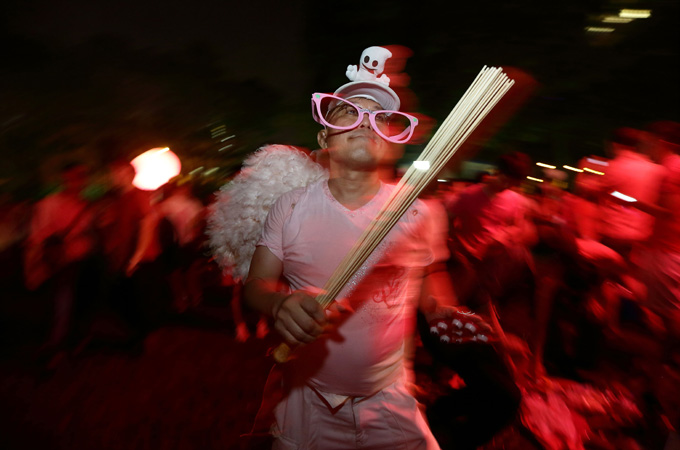
“Pink Dot Sg” – a play on words on Singapore’s nickname, Little Red Dot – is an open-air event where thousands dress in pink and gather to form a giant dot in support of lesbian, gay, bisexual and transgender (LGBT) causes. The festival marks its fifth year on June 29, and the organisers say they expect turnout to be enormous.

Attendance estimates for the first Pink Dot event in 2009 ranged from 500 to 2,500, while last year’s event drew a record 15,000 people.

Major corporations have begun to sponsor the event, including Google, JP Morgan, and Barclays.

“The growing number of companies who are coming out and supporting social movements like Pink Dot is humbling,” says Paerin Choa, spokesperson for Pink Dot Sg. “Increasingly, corporate entities are recognising the importance of values like inclusiveness and diversity, not just in the creation of a good working environment for employees, but also as a gesture of goodwill to clients and customers.” Continue reading …

Hagel on the Asian pivot, China, and cyber espionage

US Defense Secretary Chuck Hagel delivered two messages this morning to the annual Shangri-La Defense Dialogue in Singapore: he reaffirmed the Obama administration’s strategic “pivot,” or “rebalance” of its focus and resources from the Middle East to Asia, and specifically named China as a source of cyber espionage that threatens US and global security.

Hagel called the Asia-Pacific region the emerging “center of gravity” for world population, global trade, and security. Mandatory spending cuts on the Defense Department will not prevent Washington from allocating new resources and increasing its presence in the region, Hagel said. “The world is undergoing a time of historic transformation, and Asia is at the epicenter of that change,” he said.

Increased partnerships and engagement with countries throughout the Asia-Pacific are designed to encourage inclusive, transnational cooperation on the largest problems facing the region, Hagel said. “Relationships, trust, and confidence are what matter most to all nations,” he said.

Hagel put North Korea on notice that the US will not stand by as it makes nuclear threats, calling on the rogue nation to denuclearize and become a responsible member of the world community; and called for territorial disputes in the South China and East China seas to be settled with restraint, without force, and according to international law.

Hagel also named China as a source of cyber espionage targeting military and government secrets, reflecting Washington’s increasing willingness to directly confront China following reports last week of Chinese hackers stealing secrets from US military systems.

“The United States has expressed our concerns about the growing threat of cyber intrusions, some of which appear to be tied to the Chinese government and military,” Hagel said. “We are determined to work more vigorously with China and other partners to establish international norms of responsible behavior in cyberspace.” Continue reading

Singapore Has Its First Gay Magazine Through This Digital Workaround

Published by The Atlantic, May 14, 2013

To get around restrictions on homosexual material, Element turned to app stores

A woman dances as she takes part in a Pink Dot Sg event at the Speakers' Corner in Hong Lim Park in Singapore June 30, 2012. About 15,000 people took part in the event to promote acceptance of the Lesbian, Gay, Bisexual, Transgender community in Singapore. (Tim Chong/Reuters)

A woman dances as she takes part in a Pink Dot Sg event at the Speakers’ Corner in Hong Lim Park in Singapore June 30, 2012. About 15,000 people took part in the event to promote acceptance of the Lesbian, Gay, Bisexual, Transgender community in Singapore. (Tim Chong/Reuters)

By Tom Benner

While Western countries debate the merits of gay marriage, countries in Southeast Asia remain far less accepting of homosexuality.

In socially conservative Singapore, where sexual contact between men is still punishable with up to two years’ jail time, an online-only magazine targeted to gay men in Asia launched last month, with a second issue due in June. It is something of a test case for media and cultural barriers.

For a population that both shows signs of slowly accepting of gay culture, and embraces the digital media formats that allow the publisher to bypass local media licensing requirements for print publications, the timing may be right for Element, a magazine that covers fashion, entertainment, fitness, and issues relevant to the Asian gay community.

“It’s an excellent moment,” said Hirokazu Mizuhara, the managing director and creative force behind the bi-monthly e-magazine. “A few years back a digital magazine probably wouldn’t be able to garner a lot of attention. In Singapore, given that it’s a very digital society, a purely e-magazine can have the same effect as a printed version.”

By limiting the publication to an electronic version — available on digital platforms such as the Apple App store and the Android Market — and using an Internet host server based in the United States, Element bypasses licensing requirements set by the Singapore government, which regulates locally produced content, and eliminates the need for a print distribution.

While the e-magazine’s publisher touts the lucrative market for the “pink dollar” in Asia, Singapore is surrounded by countries where homosexuality remains illegal (such as Malaysia) or meets with strong disapproval (such as Indonesia). That makes the online-only gambit seem necessary. Continue reading …

Ice cream in Singapore, coffee in Pyongyang

(Saturday profile in Today newspaper, April 20, 2013)

By Tom Benner

The United States and South Korea are on high alert over North Korea’s nuclear threats. But far from the frenzied actions of officialdom grappling with the situation, a group founded by young Singaporean professionals has been quietly making inroads and building bridges with their peers in North Korea.

The Choson Exchange, a Singapore-registered non-profit, has for the last three years regularly sent volunteers to Pyongyang and Rason, and more recently brought North Koreans to Singapore, seeking to connect young people and institutions in North Korea with workshops and training in economic policy and international business and finance.

“What really surprised me was how they seemed like any other normal young people,” Choson Exchange volunteer Desmond Lim said of a trip that brought five young North Koreans to Singapore last year for month-long internships.

“The girls really liked ice cream, so I was taking them to Ben & Jerry’s and Cold Stone. They would have double scoops and triple scoops. The girls liked to shop, the guys didn’t.” Continue reading …

Boston, terror, and unfinished business

By Tom Benner

Sept. 11, 2001, was going to be crazy day for me, no matter what. Yesterday’s horror at the Boston Marathon brought me back to that time, and reminds me of the unfinished business of that day.

At the time I normally went to work at the press gallery of the Massachusetts State House, where I served as bureau chief for a daily newspaper. But on Sept. 11, I was scheduled to go to the paper’s main newsroom, where I was filling in for the vacationing editorial page editor.

Then, that evening, I would shift back into reporter’s mode and cover that day’s primary election to nominate a replacement for a recently deceased congressman from Boston. The election results wouldn’t come in until 10 pm or later, so it was going to be a long day.

I remember looking in the bedroom mirror, tying my tie and about to step out for my drive to the newsroom, when a radio reporter with scant information said something about a plane hitting the World Trade Center. This was 10 minutes or so before 9 am, it had just happened, and there was no way to gauge the enormity of what was to come. Continue reading

Aircraft carrier diplomacy

StennisPhoto

Singapore’s importance in the US “Asia pivot” – or “rebalancing,” as some in foreign policy prefer to call it – is underscored this week by two visits: Singaporean Prime Minister Lee Hsien Loong’s meetings in Washington with President Obama and Defence Secretary Chuck Hagel, and the docking of the nuclear-powered aircraft carrier USS John C. Stennis at Singapore’s Changi Naval Base.

The cordial meeting between Obama and Lee at the White House marks strong military ties and cooperation between the two nations, with new rotational deployments of US Navy vessels – as many as four littoral combat ships — in Singapore starting later this month, as the US looks to boost its Asia-Pacific presence. Littoral combat ships are surface vessels designed to operate in shallow waters close to shore, according to a US Embassy media release.

Hagel, hosting PM Lee at the Pentagon, discussed issues including tensions in the South China Sea, and accepted an invitation to speak in Singapore at the annual Shangri-La Dialogue, which is held May 31 to June 2. Secretary of State John Kerry with visit Northeast Asia next week, amid tensions on the Korean peninsula.

Meanwhile, at Changi Naval Base, visitors over the past few days got to board the USS Stennis, which performs something of a showboat/PR function when it isn’t seeing action (the Stennis launched the final sorties which brought the Iraq War to a close in 2011, and recently completed a five-month tour providing air support to allied troops on the ground in Afghanistan.). As a colleague described it, the carrier is like something out of Top Gun, the size of four football fields, and carries 6,500 crew and airmen at maximum capacity, and 70-plus aircraft. The floating military base leaves Singapore today for Hawaii before heading to its home port in Washington State.

Secretary Kerry and PM Lee make remarks in this newly released video on YouTube.

Learning to speak up, and learning to be published

I spoke to a group of students recently on advocacy journalism. As future early childhood educators at Wheelock College-Singapore, the students will enter the workforce with the need and desire to articulate the methods and goals of their chosen profession.

We talked about the difference between “objective” news writing and opinion writing, which can range from longer commentary pieces to the letter to the editor, the blog post, or even the tweet. We discussed the importance of a good “hook” to engage the reader; the importance of structure and how to build an argument; the importance of self-expression and policy debate in an open society; the importance of disagreeing without being disagreeable; the importance of accuracy and of attribution; and the importance of anything we write passing the “So What?” test.

A newspaper traditionally expresses editorial board views in its editorials, and offers a place for the opinions of others opposite the editorial — hence the term “op-ed.” At the end of our session we broke into small groups to write opinion pieces on a story that had run that morning in the Singaporean newspaper, Today, about the value of unstructured play in a child’s skills development. The story focused on a view among many Singaporean parents that learning examinable skills is far more important than play, contrasting that view with the Finnish approach to early childhood education, which places a value on play and its interactive possibilities (or experiential learning, as it is cleverly called).

At the end of our session, I encouraged the students to submit their writings to the newspaper’s commentary page, and left them with instructions on how to submit an op-ed or a letter to the editor. I am delighted to report that two pieces were published, including this op-ed headlined Get serious about embracing play, by Jane Mayriel Singh and Nathania Tan Hui Yi, final year students of the Bachelor of Science in Early Childhood Studies and Leadership program at Wheelock College-Singapore. A letter to the editor, by students Cheok Jia Hui Sophie Chantel and Nurshafain Bte Basir Ahamed, also was published, but a link is unavailable.

Congratulations to these aspiring early childhood educators and now, published writers.

Why waste so much if we love food?

Op-ed published in the Sunday Straits Times, March 24, 2013

Photo: Zakaria Zainal

Photo: Zakaria Zainal

By Tom Benner

Singaporeans tossed out some 675 million kilos of food in 2011, according to the National Environment Agency, a vast amount that exposes the casual attitudes and habits of living in a food paradise and land of plenty.

This may seem surprising for Singapore, a small island that imports most of what is consumed. Singaporeans are second to none in their love of food, yet one routinely sees unfinished plates getting scraped into rubbish bins, from hawker centres to high-end restaurants and catered affairs.

It is not just a Singapore problem; it is a part of a global problem of growing proportions.

Food loss and food waste occur at alarming rates – about one-third of all the food produced for human consumption, some 1.3 billion tonnes of food worth around US$1 trillion (S$1.25 trillion) – is lost or wasted each year. At the same time, world food demand grows; about one billion people are undernourished globally. Read more …

Let’s converse like adults

Op-ed published in Today, Feb. 27, 2013

By Tom Benner

It would not be like forward-looking Singapore to ignore the factors that will determine its future. Nor would Singaporeans, however upset some may be over the White Paper on Population, want a Government that isn’t thinking for the long term.

The 76-page paper is a thoughtful document with good underlying research and some important recommendations about how to tackle the problems of a rapidly ageing population with one of the lowest populations in the world. It seeks to engage Singaporeans in an adult conversation. Easing work-life issues, infrastructure needs such as housing and mass transit, and balancing future immigration levels against the Singaporean identity all have a place in the discussion.
Continue reading …