Why waste so much if we love food?

Op-ed published in the Sunday Straits Times, March 24, 2013

Photo: Zakaria Zainal

Photo: Zakaria Zainal

By Tom Benner

Singaporeans tossed out some 675 million kilos of food in 2011, according to the National Environment Agency, a vast amount that exposes the casual attitudes and habits of living in a food paradise and land of plenty.

This may seem surprising for Singapore, a small island that imports most of what is consumed. Singaporeans are second to none in their love of food, yet one routinely sees unfinished plates getting scraped into rubbish bins, from hawker centres to high-end restaurants and catered affairs.

It is not just a Singapore problem; it is a part of a global problem of growing proportions.

Food loss and food waste occur at alarming rates – about one-third of all the food produced for human consumption, some 1.3 billion tonnes of food worth around US$1 trillion (S$1.25 trillion) – is lost or wasted each year. At the same time, world food demand grows; about one billion people are undernourished globally. Read more …
Let’s converse like adults

Op-ed published in Today, Feb. 27, 2013

By Tom Benner

It would not be like forward-looking Singapore to ignore the factors that will determine its future. Nor would Singaporeans, however upset some may be over the White Paper on Population, want a Government that isn’t thinking for the long term.

The 76-page paper is a thoughtful document with good underlying research and some important recommendations about how to tackle the problems of a rapidly ageing population with one of the lowest populations in the world. It seeks to engage Singaporeans in an adult conversation. Easing work-life issues, infrastructure needs such as housing and mass transit, and balancing future immigration levels against the Singaporean identity all have a place in the discussion.
Continue reading …

Image

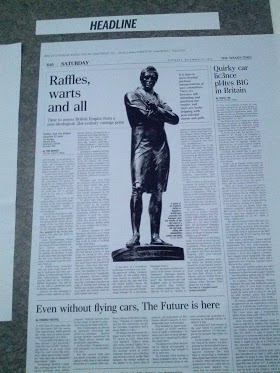
Headline of the month

HeadlineStraitsTimes
‎”Headline of the month” at the Straits Times office. My piece, but not my headline, unfortunately.

Vietnam’s lessons for Obama’s new team

Op-ed published in Today, Jan. 30, 2013

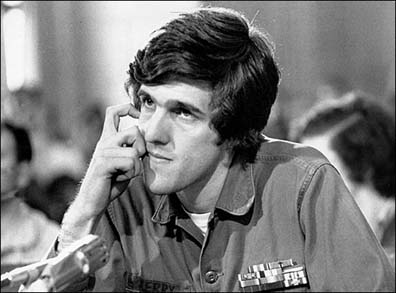
John Kerry, then director of Vietnam Veterans Against the War, testifies before the Senate Foreign Relations Committee on April 22, 1971

John Kerry, then director of Vietnam Veterans Against the War, testifies before the Senate Foreign Relations Committee on April 22, 1971

By Tom Benner

Last Thursday, I took a flight to Hanoi. An American tourist in Vietnam, I know, is a remarkably unremarkable thing, but for those of a certain age, the past poses questions for the present.

That same day in Washington, confirmation hearings began for Senator John Kerry to become President Barack Obama’s Secretary of State. And a few days from now, former Senator Chuck Hagel comes up for his confirmation as Secretary of Defence.

Before they become the two top members of the United States’ foreign policy team, Mr Kerry and Mr Hagel face the scrutiny of a third senator, Mr John McCain, a key figure in the nomination process and a respected foreign policy sage.

The three men have a war in common. Back in 1969, Mr Kerry was commanding a riverboat in South Vietnam. Mr Hagel had just served in the same infantry squad as his younger brother, Tom. Mr McCain was two years into his five-and-a-half year stint as a prisoner of war in Hanoi.

That same year I was 10, growing up in the safety and comfort of a small American town. Only occasionally did I hear the word Vietnam, generally in the context of someone we knew, a cousin we loved or friends of my older siblings, getting sent there. Continue reading …

The problem with kicking the can down the road

Op-ed published in Today, Jan. 4, 2013

showimageCC.aspx
US President Barack Obama may have obtained a fiscal deal that he could live with, but his administration must now begin to prepare itself for ‘March Madness’ – the debate over the debt ceiling. Photo: Reuters Copyright © MediaCorp Press Ltd

By Tom Benner

The United States fiscal cliff – an end-of-year deadline for automatic federal tax increases and across-the-board spending cuts, set by leaders frustrated by their own inability to fix America’s budget problems – has been averted.

That is good news in the short term, because the fiscal cliff plan threatened to push the country back into recession. The trouble is, not much really got solved.

There are several ways of looking at the fiscal cliff deal that passed this week.

From a policy perspective, all the big issues were left for another day. There is no agreement on raising the debt ceiling, heading off the threat of a government shutdown and reaching long-term debt stabilisation. Continue reading …

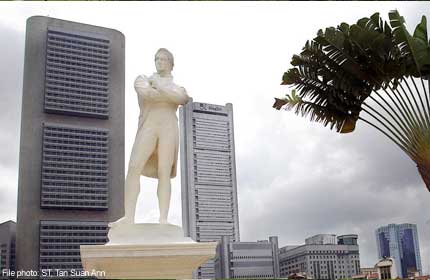
Raffles, warts and all

Published in The Straits Times and AsiaOne, Tuesday Jan. 1, 2013
20121231.143129_dec3112_stamfordraffles
By Tom Benner

SINGAPORE, as we all know, is filled with streets, schools, hospitals and businesses named Stamford or Raffles, after Sir Stamford Raffles, the acknowledged founder of the place.

A new book sheds new light on the man, his exalted place in history, and the dark side of British colonialism. Yet despite it being the top-selling title at last month’s Singapore Writers Festival where it made its debut, the book has yet to prompt much in the way of a Raffles re-evaluation.

There is time for that; in the years leading to the 200th anniversary of the 1819 founding of modern Singapore, Raffles is sure to get a sizing-up by modern standards. Continue reading …

The “Father of Singapore” portrayed in a new and critical light

BookJacket

By Tom Benner

The top-selling book at the recent Singapore Writers Festival offers a controversial reassessment of Singapore’s founding father. Sir Stamford Raffles comes off as the brutal face of British imperialism – far from the high-minded English gentleman and heroic figure of popular conception – in Tim Hannigan’s new book Raffles And The British Invasion Of Java.

The author, who will discuss the book at Select Books on Armenian Street in Singapore on 15 December 2012 at 5 pm, portrays Raffles as a wildly ambitious opportunist who could be manipulative, devious, thieving, jealous, and petty.

Hannigan, a British-born freelance journalist and photographer who divides his time between Cornwall, UK, and Indonesia, says he was motivated to write the book by a commonly held view among Indonesians that their country would be more advanced today – more like Singapore – had it been colonised by the British, not the Dutch.

The short-lived and largely forgotten British period of Indonesian history started with the Raffles-led British seizure of Java from the Dutch in 1811. With Raffles assuming the post of lieutenant-governor at age 30, the turbulent, five-year rule known as the British Interregnum was marked by thievery, brute force, and wanton destruction, Hannigan asserts. Continue reading

For the GOP, a roadmap back from irrelevance

Op-ed published by International Network of Street Papers and Spare Change News, Dec. 5, 2012

By Tom Benner

Republican uber-strategist Karl Rove’s election-night meltdown on live television put a human face on the GOP’s willful self-delusion. Mitt Romney, who didn’t prepare an Election Night concession speech, ran a campaign based on yesteryear’s party values, policies, and world view. “It’s not a traditional America anymore,” moaned Fox News conservative commentator Bill O’Reilly.

The wake-up call was overdue. For the sake of a vibrant American two-party system, the GOP needs to change with the times and regroup into a party that matters to more than just the conservative entertainment complex.

That includes embracing modern demographics, expanding the party base beyond Tea Party extremists and the very rich, and some serious soul-searching over how the once-proud Party of Lincoln can be relevant in the 21st Century. Continue reading

The things that work: A Boston-Singapore comparison

Op-ed published in Today, Nov. 22, 2012

Coming from a Boston native, the bus and rail system here is a pleasure to use, very reasonably priced; any inconveniences and breakdowns cannot compare to those in Boston. TODAY FILE PHOTO
Copyright © MediaCorp Press Ltd


By Tom Benner

I moved from Boston to Singapore a few weeks ago, and I can’t help but compare the two places. As someone who is interested in public policy and how it can enhance quality of life, I noticed a few things right away that work on Singapore’s behalf.

GETTING AROUND

In Boston, the much-maligned mass transit system is immortalised by the old folk song Charlie on the MTA, about a man who boarded the subway but didn’t have the nickel to pay the exit fare. So he rode the subway for good, his wife throwing a sandwich through an open railcar window to him each day at the Scollay Square station. He was, as the song goes, “the man who never returned”.

Investing in affordable and efficient mass transit just isn’t as big a priority in Massachusetts – too much competition and political influence from the suburban car crowd who insist on highways that are well paved, well maintained and well patrolled. Continue reading …

The right visit at the right time

Op-ed published in Today, Nov. 21, 2012

US President Barack Obama and Secretary of State Hillary Clinton visiting the Shwedagon Pagoda in Myanmar on Monday. REUTERS
Copyright © MediaCorp Press Ltd

By Tom Benner

Critics in the United States and around the world offered plenty of reasons why President Barack Obama shouldn’t have gone to Myanmar on Monday.

Some called the visit premature, saying the country’s military junta has yet to atone for decades of human rights atrocities. Others worried it will be counterproductive, leaving the relatively new, nominally civilian government feeling complacent as political prisoners remain locked up. Ethnic and religious violence continues to make headlines and worry the global community.

Instead of listening to the naysayers, Mr Obama seized a historic opportunity in Myanmar and history may bear him out. Continue reading…