Christie-Nixon comparisons are nothing new

Published by The Daily Record, Feb. 6, 2014

By Tom Benner

“Chris Christie, Meet Richard Nixon.”

That was the headline we put on an opinion column that appeared on Dec. 18, 1996, in the Daily Record, where I served as editorial page editor.

Richard Nixon wasn’t around to complain about the comparison, but Chris Christie sure was.

Christie was a young, aspiring politician at the time, brash and self-assertive in style, and he wasn’t shy about calling me on the phone to sell me on his way of seeing things. This time he was really miffed when he called. He insisted that such a comparison was completely unfair and off-base, and how could we allow it?
Continue reading …

Singapore soul searching follows migrant riot

Published by Al Jazeera English, Dec. 18, 2013

Deportations follow last week’s unrest in Little India as officials debate the best way to move forward.

By Tom Benner and Satish Cheney

Singapore – A heavy reliance on cheap foreign labour – and whether low-paid, low-status guest workers in this wealthy island-nation are treated fairly – is the cause for soul-searching and debate following a rare riot on December 8 in the Little India neighborhood.

The city-state will deport 53 people who were allegedly involved in the unrest.

Government officials blame alcohol for the riot – Singapore’s first in 44 years – which started after an Indian national was struck and killed by a bus that was ferrying foreign labourers from the Indian district to their dormitory-style living quarters. Some 400 people charged the bus and first responders, threw objects, and overturned police cars and damaged other vehicles, injuring 39 people and sending shock waves through the orderly, law-abiding country. Continue reading …

Singapore riot ignites burning class issues

Published by Al Jazeera English, Dec. 10, 2013

Experts say problems around foreign labour need to be addressed after Sunday’s riot by Indian and Bangladeshi workers.

Tom Benner

Singapore – Every Sunday as evening falls, tens of thousands of foreign-born transient workers from southern India and Bangladesh gather on the sidewalks and open fields of this city’s ethnic Indian neighborhood. For most, it is their one day off from the construction site or other job location, their one night out to eat, drink, and socialise with friends.

Low-paid migrant workers toil amid the seemingly incompatible demands of class-conscious Singaporeans, who don’t want to perform the dirty and sometimes dangerous manual labor involved in building the physical infrastructure underlying the island-nation’s economic miracle, but who simultaneously worry about the presence of too many guest workers living in their midst and clogging up sidewalks, trains and buses. Continue reading …

Singapore poverty in the spotlight

The island’s rich get richer while its poor get poorer, prompting calls for an official poverty line to be set

(Published by Al Jazeera English, Nov. 9, 2013)

By Tom Benner

Singapore – Begging is illegal here, under the island-nation’s Destitute Persons Act, carrying a fine of up to $3,000 or imprisonment for up to two years for repeat offenders.

But Singapore’s poor still can be found, often selling packets of tissues outside food centres. Or spending the night on benches near their jobs to save the transport fare home – they are commonly called “sleepers”. Or collecting empty soft drink cans out of trash bins.

The poor have no place in Singapore’s vaunted success story, but there are growing calls for one of the wealthiest countries in the world to acknowledge rapidly rising income inequality by setting an official poverty line. Hong Kong’s recent decision to set a poverty line as a way to better identify and assist its poor has prompted a similar debate in Singapore’s parliament. Continue reading …

Can East Timor dodge the ‘resource curse’?

Despite oil and gas riches, signs of wealth remain scarce in the impoverished country.

Photo: Wong Pei Ting

Photo: Wong Pei Ting

Published by Al Jazeera English, Nov. 1, 2013.

By Tom Benner

Dili, East Timor – The 2014 budget unveiled last week by tiny East Timor is a $1.5bn spending plan funded almost exclusively – 95 percent – by lucrative oil and gas revenues. One of the fastest-growing budgets in the world in recent years, it ballooned from $64m in 2004 to $604m in 2009.

That the budget depends on a single, finite resource that could be depleted in a generation has some worrying the country may fall victim to the same “resource curse” that has seen other developing countries lose their wealth to inexperience, mismanagement and corruption.

“Given how much money has poured through the country, and given how much money the government has access to, it’s fairly depressing,” said Anna Powles, an academic researcher who worked in East Timor for eight years as an adviser to the government and several non-government organisations.

East Timor is one of the most oil-dependent countries in the world, according to the International Monetary Fund. The country’s non-oil industries, such as organic coffee and tourism, generate a fraction of the amount as the oil does. Continue reading …

‘Resource curse’ haunts Timor-Leste

Op-ed published in Today, Oct. 25, 2013

In Timor-Leste’s capital of Dili, young men walk the streets aimlessly; youth unemployment is over 50 per cent in a country where more than 60 per cent are under 25. Photo: Wong Pei Ting

In Timor-Leste’s capital of Dili, young men walk the streets aimlessly; youth unemployment is over 50 per cent in a country where more than 60 per cent are under 25. Photo: Wong Pei Ting

By Tom Benner

There is a free health clinic in Dili, the capital of Asia’s newest and poorest country, Timor-Leste, that treats some 400 people a day. The doctor who runs it was telling me about the kinds of cases he generally treats — tuberculosis, malaria, dengue, typhoid, malnutrition, stunting, poor growth, pregnancy complications.

Dr Dan Murphy is actually happy about this. Back before Timor-Leste became a country in 2002, he treated gunshot wounds, machete wounds, victims of torture and hand grenade victims.

What passes for progress in Timor-Leste is a lot like that. The war zone days are over, but the patient at the door has new problems with endemic causes. Now that United Nations (UN) peacekeepers are gone and the civil unrest has quieted, the challenges of governing a very poor country and inexperienced democracy seem far greater than anticipated in the hopefulness of its first sovereign days. Continue reading …

Mismanagement highlighted in East Timor

Contracts with a Chinese company lead critics to blast government for alleged poor procurement policies.

Published by Al Jazeera English, Oct. 19, 2013

By Tom Benner

Dili, East Timor – East Timor’s government has come under renewed public criticism after granting a contract to a Chinese state-owned company to supply furniture to Timorese schools.

The contract of just over $1m is relatively small for a country with oil and gas wealth, but its significance is larger. In 2008 the prime minister, Xanana Gusmao, granted the same company a $300m contract – the largest in the nation’s history at the time – to build East Timor’s power plants and national electricity grid.

The company, Chinese Nuclear Industry Construction Company No. 22 (CNI22), was widely criticised for its failure to fulfill the terms of the contract, and a big portion of the work had to be reassigned to a different company, increasing the cost by hundreds of millions of dollars and delaying the project for several years.

“We hope that they will never receive another contract from East Timor,” a government watchdog group, La’o Hamutuk (Walking Together), wrote in an October 8 letter to the chairman of the National Procurement Commission. Continue reading …

East Timor leaders eye media curbs

Draft law would restrict who can be a journalist and punish ethical transgressions

Published by Al Jazeera English, Oct. 17, 2013

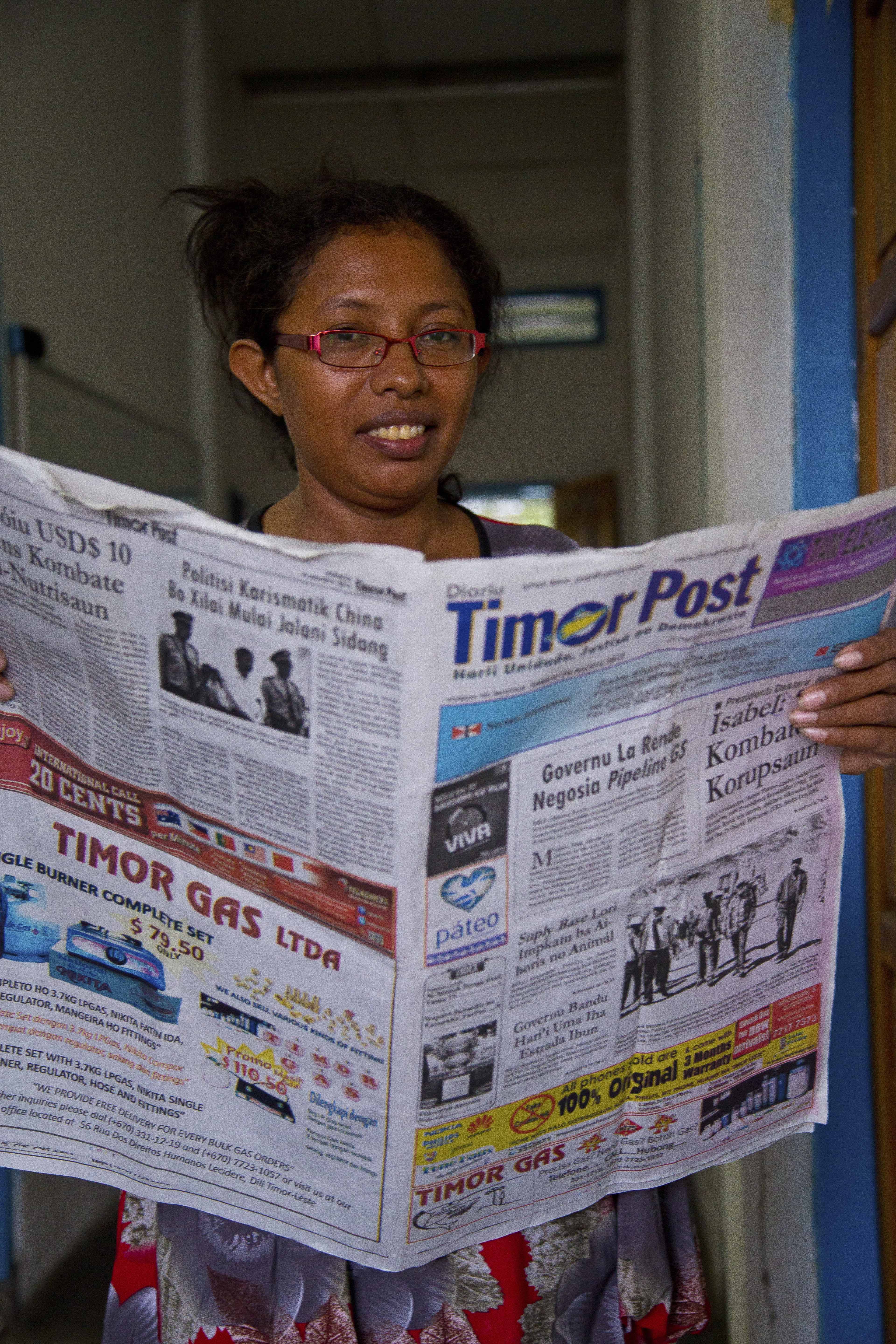
Rosa Garcia of the Timor Post. Photo by Wong Pei Ting

Rosa Garcia of the Timor Post. Photo by Wong Pei Ting

By Tom Benner

Dili, East Timor – Media in this young democracy in Southeast Asia suffer from a lack of professionalism, accuracy, and ethics, argue proponents of new legislation that would punish journalistic transgressions.

But critics worry that such a law, expected to be taken up by East Timor’s parliament, could impose onerous restrictions, such as spelling out who may work as a journalist, and how breaches of journalistic ethics should be addressed.

Politicians such as former prime minister Mari Alkatiri are advocates of such a system, alarming free speech advocates in the country.

“Media is a power. Every power has to have some limits,” Alkatiri said in an interview at his office in Dili, the nation’s capital.

“If the politician made a mistake, he has to respond to his mistake. If a company makes a mistake, they have to respond to the mistake. But the journalist, no. They are free to have mistakes, because they are journalists.” Continue reading …

North Koreans are visiting Singapore – whither the ‘hermit’ kingdom?

A nonprofit in Singapore is paving a path that some say may help open up North Korea to the outside world and stoke interest in private commerce and economic growth there.

Published by The Christian Science Monitor, Sept. 18, 2013

By Tom Benner, Contributor / September 18, 2013

Singapore

Neither Dennis Rodman nor tough talk from Washington and Seoul have improved relations with the new regime in North Korea.

But a little-known professionals’ network is trying to pave a path that may help open up the reclusive North to the outside world and stoke interest in private commerce and economic growth there.

The Choson Exchange, a nonprofit based in Singapore, regularly sends business volunteers to Pyongyang and brings North Koreans to Singapore, in an effort to connect young people through workshops in economic policy, international business, and law.

The group’s ability to network with young North Korean professionals signals an apparent willingness within the regime to open up to market ideas, the one force that analysts say can drive positive change in the country. “The idea behind all of this,” says Geoffrey See, the founder of the program, “is that we would like to see North Korea integrate with the rest of the world.” Continue reading …

Global education lessons: Singapore leads in STEM, now takes on the arts

Just as the US is abandoning funding of arts programs in schools to focus more on testing of core subjects, a leader in math and science education turns to the arts as a way of improving “entrepreneurial” thinking it admired in Americans. Will it beat the US at it’s own game?

Published by the Christian Science Monitor, Sept. 1, 2013

By Tom Benner

Chew Jun Ru knew he wanted to become a musician back in high school. But the eldest of four had parents who shared the traditional Singaporean view of the arts – they insisted he find a career with a solid future.

“It was crazy at the time. They could not believe what they were hearing,” says Mr. Chew, now 24. “It’s just music. I’m not doing drugs. It’s not something I should be ashamed of.”

In June, Chew – who plays the erhu, a traditional Chinese two-stringed bowed instrument – graduated from Nanyang Academy of Fine Arts, an undergraduate arts institution here. In August he left for Beijing on full scholarship to the China Conservatory of Music.

His ability to win over his parents – they couldn’t be prouder now – speaks to the growing acceptance of, and focus on, arts education.

Innovation and creativity are seen as increasingly important to core curricula in this traditionally buttoned-up financial center, at a time when American schools are cutting back on arts. Singapore‘s embrace of the arts isn’t just for art’s sake, but because of the growing recognition that arts education is crucial to Singapore’s growing innovation-driven economy.

Continue reading …